
Case 01 · Strategic technology partner · Live
WaterDoctor: the AI agent stack behind biological water treatment.
WaterDoctor is a Singapore deep-tech company founded by NUS PhD researchers in environmental biotechnology, microbial ecology and AI. It builds AI-integrated biofilm reactors for water treatment and aquaculture. wGrow designed, built and operates the agent crew that runs its adaptive treatment loops in production.

Reported outcomes
What WaterDoctor reports.
- −50%+
- Pollutant discharge
Across pilot tanks, against the prior baseline. - −90%
- Water exchange rate
Much less make-up water needed per cycle. - −30%
- Energy per unit
Adaptive aeration in place of fixed schedules.
Outcome figures are reported by WaterDoctor. Methodology and pilot conditions are referenced in its public communications at waterdoctor.com.sg.
The relationship
A partnership with a shared roadmap.
wGrow is WaterDoctor's strategic technology partner, and this is ongoing work, not a delivered project. Our embedded crew works inside the WaterDoctor team, with the same standups, eval harness and production rota. This is the engagement we mean when we say we ship agent crews into production systems.
The problem
Biofilm treatment doesn't stay still.
Treating water with microbial biofilms is a continuous, noisy process. Sensor readings drift, the biology adapts and weather shifts the load. Static control schedules over-aerate when they should rest and recirculate when they should hold, and they chase symptoms while the microbial community changes underneath.
WaterDoctor wanted a controller that would learn the local process, and a way to prove to a regulator that it was behaving.
The crew
Four narrow agents and two senior wGrow engineers.
The engineers own the safety limits, the schema and the sign-off on every regulator-bound report. WaterDoctor's process scientists own the biology, and we own the agent stack and audit trail.
Ingestor
Takes in telemetry and lab assays.
Controller
Makes treatment decisions inside safety limits set by engineers.
Reporter
Writes run summaries a regulator can read, grounded in raw data.
Eval
Monitors deviation continuously.
The output
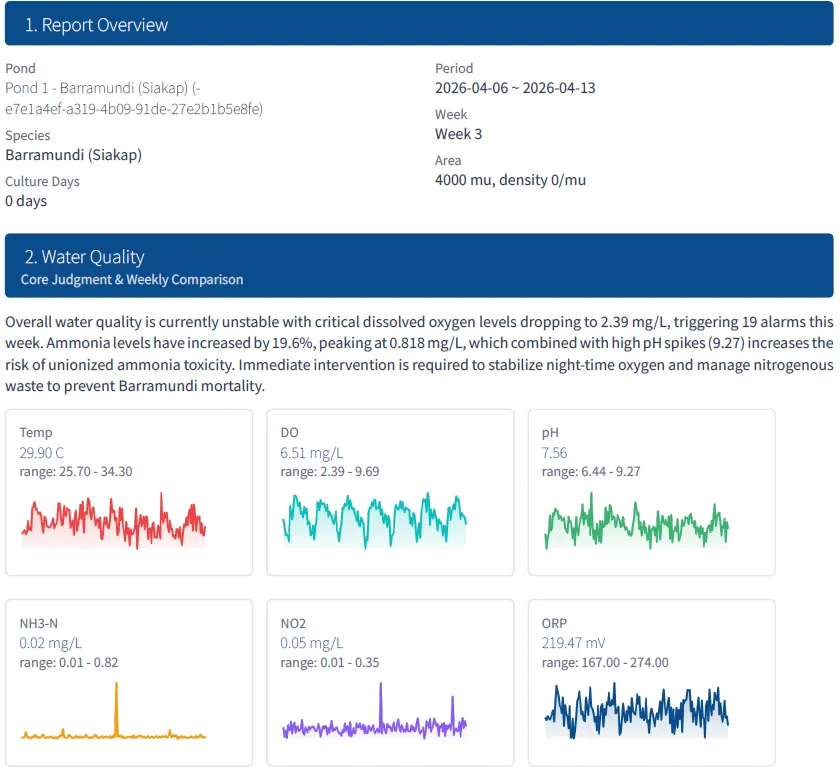
Reports that link back to raw data.
Lessons
What worked, and what we changed.
What we got right
- We kept the agents narrow. None had a job description that read like a management role.
- We set hard safety limits. The agent picks the moves, and the engineers wrote the floor and ceiling.
- Reports link back to raw data, and no paraphrased numbers leave the system.
- We had an eval harness from week one, so drift is tracked as a signal instead of being found in a postmortem.
- Decisions are made close together: WaterDoctor's process scientists sit a corridor away from our crew.
What we got wrong (and changed)
- We tried a single “ops agent” first. It was too broad. After week three we split it into ingestor, controller, reporter and eval.
- We underweighted lab-assay latency. Lab values arrive days after a sensor reading, but the controller assumed they lined up. A delayed-supervision channel fixed it.
- We auto-tuned aeration too aggressively in week six. Engineer-written guardrails caught it. We tightened the limits and added human approval for any change more than 15% from the rolling baseline.
Why we lead with it
Real tanks, under regulatory scrutiny.
Most public agentic work is chatbot demos. This system affects real tanks under regulatory scrutiny, and an environmental engineer measures the outcomes.
It is the kind of work the rebrand is for. Because we share a roadmap and a reputation with WaterDoctor, we can stay honest about what works and what doesn't.