
The crew finds the opportunity. Then defends every word of it.
Six narrow scouts run the weekly sweep — government grants, public tenders, corporate intelligence, regulatory triggers, industry events, academic collaborations. An editor dedupes, scores, and fills the bilingual EN ⇌ 简中 gaps. A verifier corroborates every claim against fresh independent searches, checks every link is live, plausibility-tests every deadline. A human BD owner promotes the verified pipeline into the CRM. We built it. We run it. The live instance ships into WaterDoctor's BD pipeline every week.
Six lanes. Two working languages. A curated registry, not a free-for-all crawl.
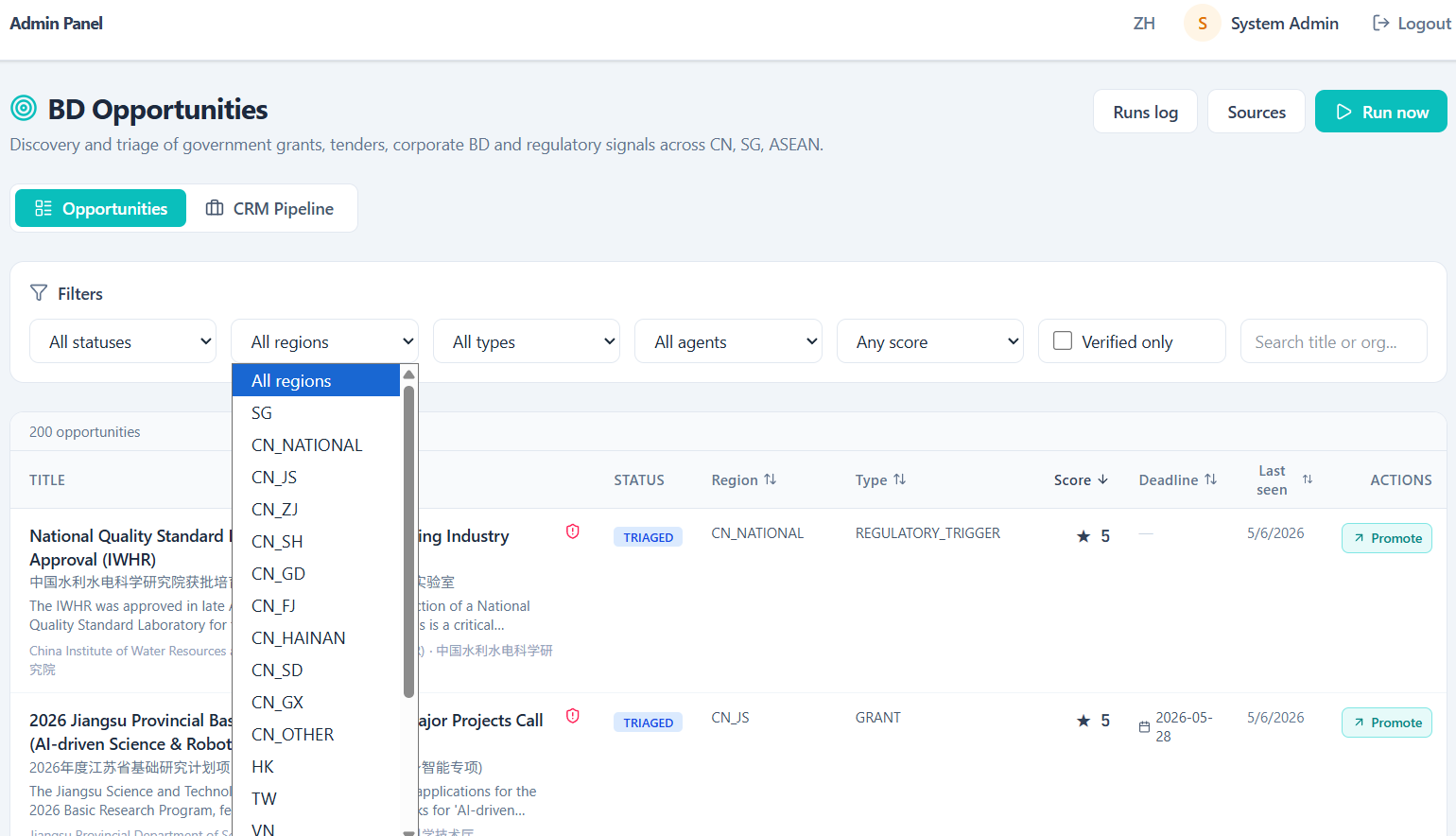
grants · tenders · corporate intelligence · regulatory triggers · events · academic collaborations. One narrow scout per lane, each with its own thematic brief and its own source list.
Singapore. China at national level plus Jiangsu, Zhejiang, Shanghai, Guangdong, Fujian, Hainan, Shandong, Guangxi. Hong Kong, Taiwan. ASEAN — Vietnam, Indonesia, Thailand, Philippines, Malaysia.
English and 简体中文 end-to-end. Local-language sources read in their own language; every opportunity surfaces with parallel EN and CN titles, summaries and eligibility notes.
Six scouts → one editor → one verifier → one human owner.
- scouts.agent (×6)Source-specialist sweep
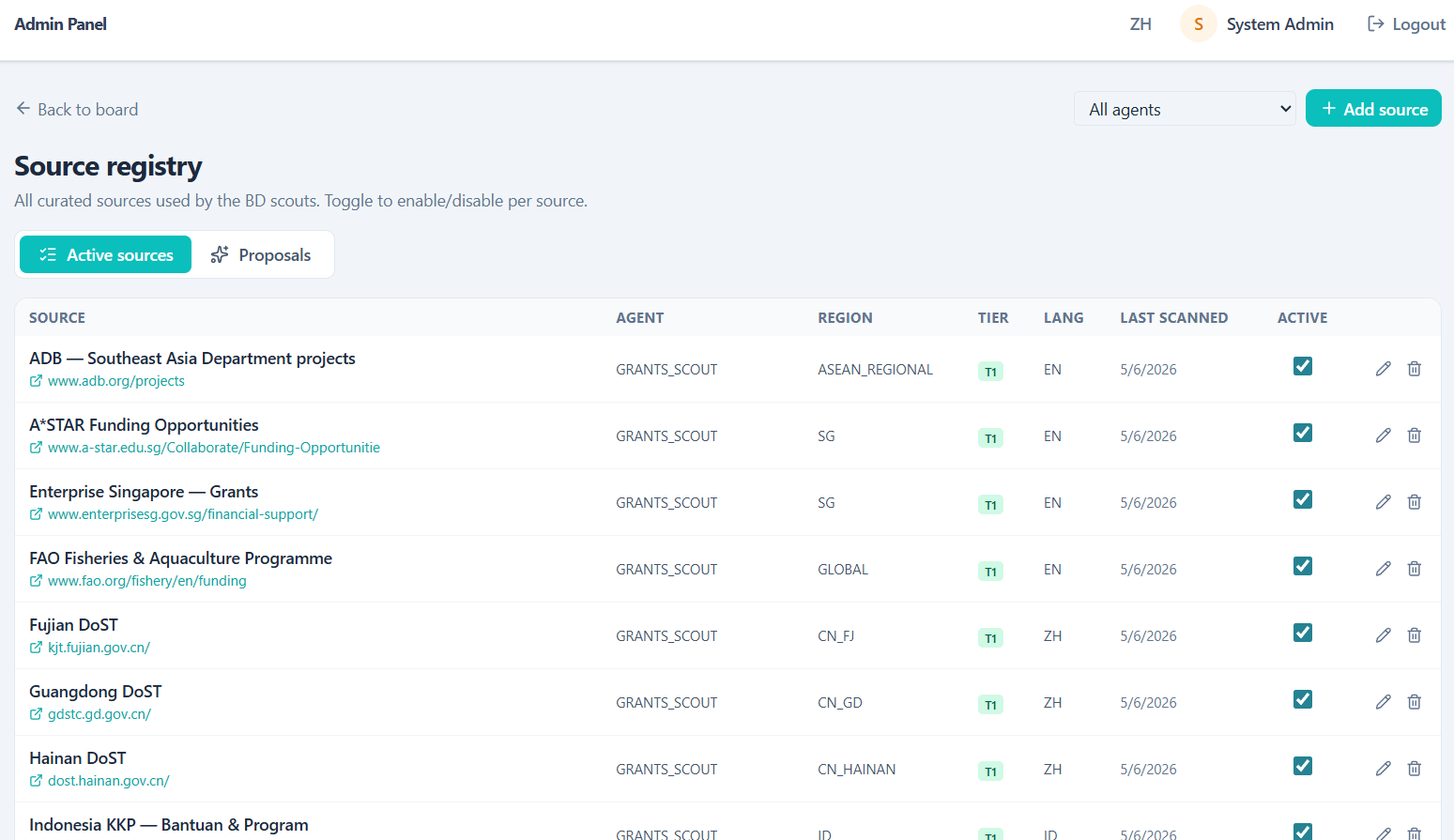
Each scout owns one source lane and one set of thematic queries. Grants tracks SFA, Enterprise Singapore, A*STAR, MARA 渔业发展补助资金, MOST 蓝色粮仓, NSFC, provincial DoSTs, ADB blue-economy TA. Tenders tracks GeBIZ plus the CN, ID, PH, TH, VN, MY procurement portals. Corporate, regulatory, events, academic each work the same way against their own brief.
- editor.agentDedupe, score, translate
Pulls every scout's findings, dedupes by source URL across lanes, scores fit · urgency · value on a 1–5 scale, fills any missing EN or 简中 side, drops anything with a fit score below the bar. Nothing fabricated, nothing paraphrased into the source data.
- verifier.agentCorroborate, then sign off
For each surviving opportunity: a fresh independent search for live corroborators, a HEAD/GET on every candidate URL for liveness, a plausibility test on the deadline. Verdict is one of VERIFIED, FLAGGED, REJECTED — and the verdict is on the record.
- BD owner (human)Promotes to pipeline
No opportunity reaches CRM follow-up unsigned. The owner approves, edits, sends back, or kills. The crew does the legwork; a person owns the pursuit.
False precision is rejected, not approved.
- Two corroborators, or a tier-1 primary. Every opportunity carries its primary source plus a corroborating-sources array. VERIFIED requires either two live independent corroborators or a tier-1 primary that's still live the week we send it.
- Title sanity is the cheapest reject. Empty title or title-equals-URL → REJECTED before a single corroborating search is spent.
- Deadline plausibility, every time. Missing deadline → FLAGGED for the human. Deadline more than five years out → FLAGGED. We do not let evergreen-looking links pass as live grants.
- Auto-retry on suspicious reject rate. When more than 70% of a batch comes back REJECTED, the rejected subset re-runs once before being persisted. Transient grounded-search flakiness should not propagate as quality data.
- A registry, not a crawl. Sources are tier-graded and curated. The crew can propose a new source — it lands in a Proposals queue. It only becomes a scanned source after the operator approves it. The crew suggests; the operator extends the registry.
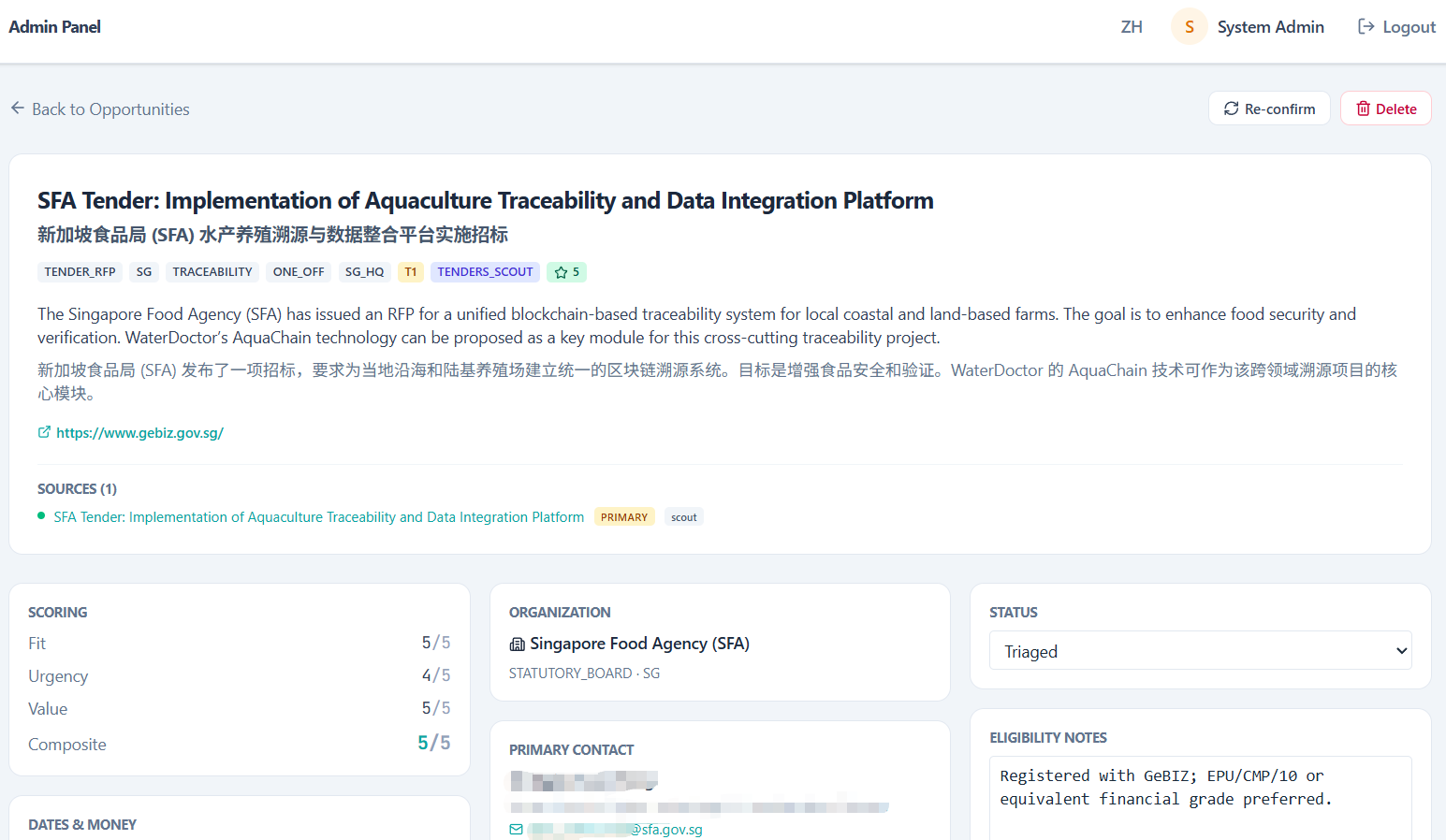
Every opportunity is graded on four axes before sign-off: corroboration depth, source-tier authority, deadline plausibility, and sector fit against the brief. Anything below threshold is sent back to the verifier or the originating scout — never to the CRM. The crew runs weekly; the registry is reviewed monthly; the brief is reviewed quarterly.
Brief us →