

Agents SDK Upgrades Need Replay Suites
By wGrow Project Team ·
Standard CI Fails Agentic Systems
The OpenAI Python SDK moves fast. You upgrade it, your test suite goes green, you deploy — and three days later an agent crew starts making decisions nobody signed off on. Standard CI checks syntax. It checks type safety and static logic. What it doesn’t check is whether the SDK now routes a tool call to a cheaper model, or whether a guardrail update just quietly dropped half your payload before your agent ever saw it. Once your runtime depends on an LLM, the failure domain shifts from compile time to run time. Plenty of engineering teams haven’t caught up to that yet — they’re still testing agentic systems like deterministic services. They aren’t. A passing unit test tells you nothing about whether v1.55.0 parses your tool schema the same way v1.54.0 did.
The Tender Evaluator Default Model Swap

We ran into this directly on our automated tender evaluation crew. The upgrade looked routine: OpenAI Python SDK from v1.54.0 to v1.55.0, mainly to pick up structured output support we’d been waiting on for weeks. What we missed was on our side, not the SDK’s: our beta tool-calling wrapper carried a default-model mapping that resolved differently once v1.55.0 landed. The trace diff showed the scoring call had shifted from our approved model to a cheaper fallback — no exception, no stack trace, the endpoint returned 200 OK every single time.
Here’s what that meant in practice: the agent started evaluating tenders against a strict government compliance rubric using a cheaper fallback model — one that simply didn’t have the reasoning depth the rubric demanded. It marked a submission compliant when it wasn’t. Our code coverage sat at 85 percent through all of this, because coverage measures whether lines execute, not whether the model called at line 340 is the one you think it is. Coverage is a proxy for correctness. In an agentic system, it’s a weak one.
WaterDoctor Guardrails and Silent Payload Drops
The second failure was worse, because it touched evidence rather than just a scoring call. WaterDoctor is our diagnostic agent for industrial water treatment plants, built on top of a deep-tech investee’s sensor telemetry. We bumped httpx from 0.27.0 to 0.27.2 alongside a related OpenAI SDK patch — both flagged low-risk in their respective changelogs. Both wrong to trust on that basis. On replay, our guardrail adapter was parsing streaming chunks differently after the bump: the diff showed evidence fields present in the raw stream but missing by the time they reached the model input.
From there, the guardrail started withholding payload content it judged unsafe or malformed. In this case that meant sensor anomaly data got silently stripped before it ever reached the diagnostic model. No error surfaced anywhere. The agent just received a truncated context window and issued maintenance recommendations off partial evidence. A guardrail that drops content without telling you isn’t a safety feature — it’s a contract change wearing one. If your downstream reasoning depends on complete evidence, you need to know the moment evidence goes missing, not just that a filter fired somewhere upstream.
Pinning httpx and openai in requirements.txt would have prevented both incidents. That’s step zero. If your team isn’t doing it, stop reading and go do it now. But pinning only defers the problem — it doesn’t solve it. Security patches and new features eventually force an upgrade, and when they do, you need something sturdier than “the tests passed.”
Building the Trace Replay Suite
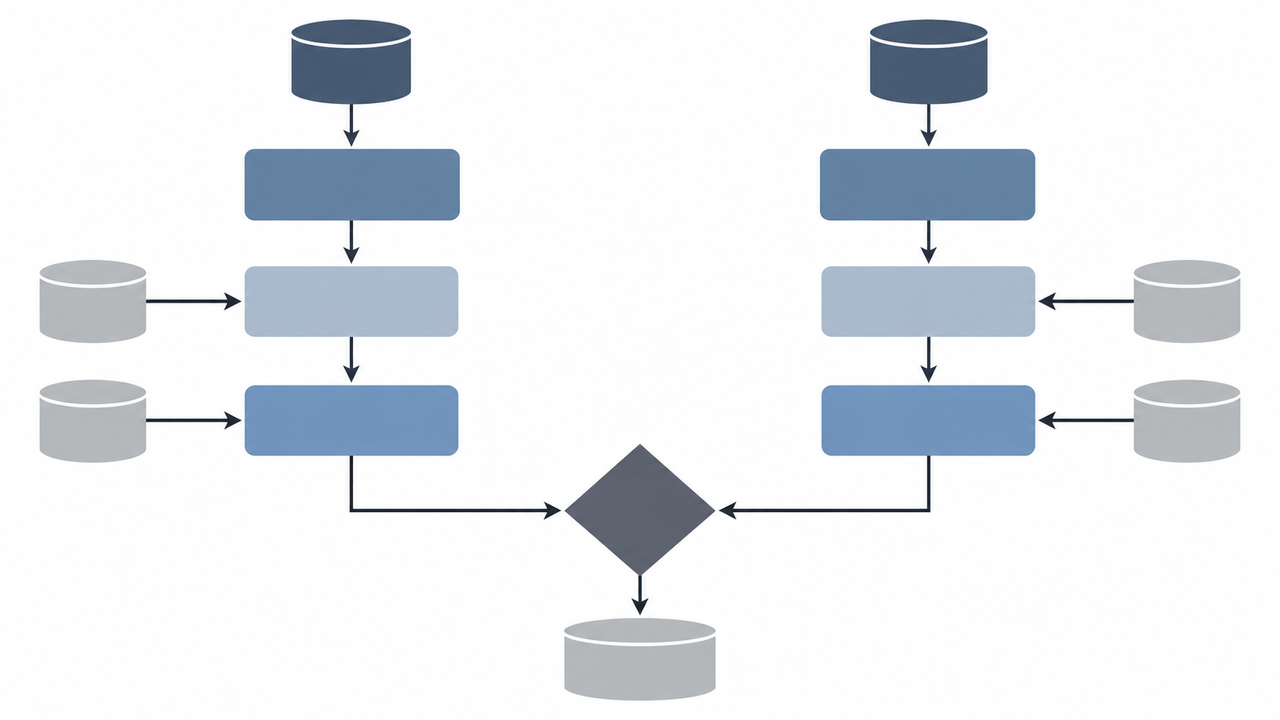
Here’s what actually worked for us: treat saved production traces as regression fixtures, the same way you’d treat golden files for a deterministic parser. Before touching an SDK version, we pull 50 to 100 successful, complex execution traces from production telemetry — initial inputs, intermediate reasoning steps, raw tool schemas, final outputs, all of it. LangSmith or OpenTelemetry will both handle the capture fine; the specific tool matters far less than capturing full state instead of a bare input/output pair.
Then we run two passes. First, routing and parsing, with the LLM endpoint mocked — checking that the upgraded SDK builds the exact same JSON payloads and internal state transitions as the version it’s replacing. This is what catches the tender evaluator problem before it ever reaches production: a silent default-model swap shows up as a different payload structure even against a mocked endpoint. Second, integration — hitting the real LLM endpoint with the new SDK and confirming context windows, guardrail limits, and cost thresholds behave the way they used to. This is where the WaterDoctor-style guardrail regression gets caught, because a replayed trace with known-good evidence content shows you exactly what got dropped and where.
Worth being honest about the tradeoff here: a replay suite only catches regressions in behavior you’ve already seen in production. A genuinely novel failure — a tool call pattern you haven’t hit yet, a rubric edge case that’s never come through the pipeline — won’t surface until it happens live. That’s a real limit, and I won’t pretend otherwise. It’s not a reason to skip the suite. It just means trace replay is a floor, not a guarantee.
Frameworks Change, Traces Remain
SDK providers will keep shipping breaking changes labeled as minor version bumps. That’s not a complaint — it’s just the operating reality of building on a fast-moving foundation model API. Static unit tests were never built for non-deterministic systems, and leaning on them alone for agent crews is a bet that the next changelog entry won’t touch anything load-bearing. Sooner or later, it will. Save your traces. Replay them before every upgrade. Treat that replay suite as the thing standing between you and a compliance agent that quietly waves through a tender it should have failed.